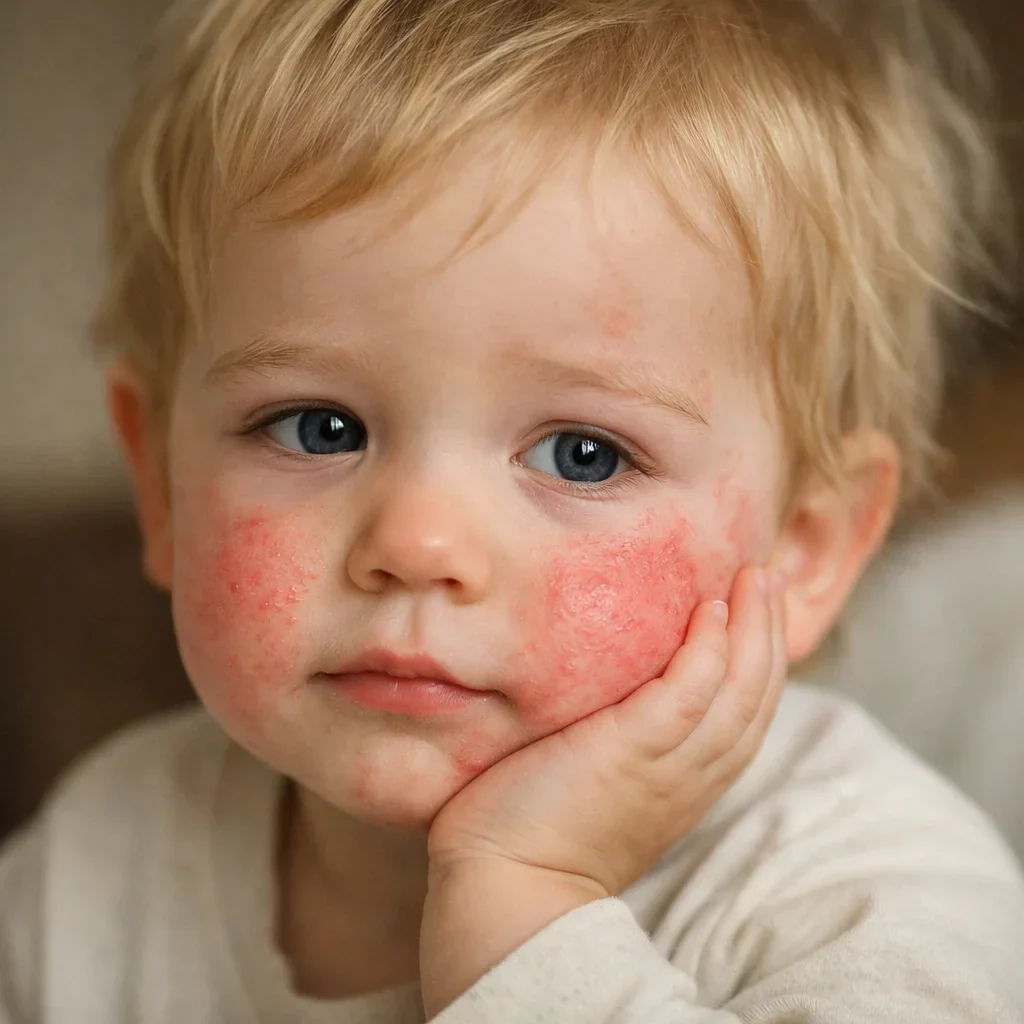
Most parents are first introduced to childhood eczema through the language of the skin. They are told their baby has dry skin, sensitive skin, or a defective skin barrier that needs constant moisturising. Creams are recommended, bathing routines are adjusted, and detergents are swapped in the hope that the surface can be corrected into calm. While these steps are not useless, they are incomplete. They treat eczema as though it begins on the skin, when in reality the skin is often the last place the problem appears.
Eczema is better understood as a visible expression of deeper biological processes that are unfolding inside a developing child. The skin does not exist in isolation. It is an immune organ, a microbial habitat, and a sensory interface between the body and the external world. When internal systems are under stress or out of balance, the skin is often where that stress becomes visible. This is why eczema behaves less like a simple dermatological condition and more like a systemic pattern with cutaneous expression.
To understand eczema properly, parents need to step back from the idea of “bad skin” and look instead at how infant biology develops. The first years of life are a period of rapid immune education. The body is learning what is dangerous, what is harmless, and how strongly to respond. This learning process is not smooth. It involves trial, error, and often overreaction. In many children, eczema is one of the earliest signs that the immune system is still finding its balance.
This reframing matters because it changes both expectations and strategy. If eczema is not purely a skin defect, then no cream, prescription, or routine can truly cure it in isolation. But if eczema is a sign of deeper processes expressing themselves through the skin, then topical care still plays a vital role. The role is not to fix the immune system, but to support the skin so it is not overwhelmed while those deeper systems mature.
The Skin as an Immune Organ, Not a Passive Surface
One of the most persistent misconceptions about skin is that it functions as a passive barrier, like a wall that either holds or fails. In reality, the skin is an active immune organ, populated by immune cells, nerve endings, and signaling molecules that constantly communicate with the rest of the body. Keratinocytes, the primary cells of the outer skin layer, are capable of producing inflammatory cytokines, antimicrobial peptides, and stress signals in response to irritation.
In infants, this immune activity is heightened because the system is still calibrating itself. The skin must learn how to tolerate harmless exposures while remaining alert to real threats. When this calibration is disrupted or delayed, inflammatory signaling can become exaggerated. The result is skin that reacts intensely to stimuli that should be benign, such as water exposure, fabrics, temperature changes, or mild detergents.
Eczema emerges in this context not because the skin is broken, but because it is overcommunicating distress. Redness, itching, and dryness are not random symptoms. They are signals generated by immune activity within the skin. This is why eczema often appears in patterns, flares unpredictably, and improves or worsens without obvious external changes.
Understanding eczema as immune-active skin changes the way parents interpret symptoms. Instead of asking “What did I put on my baby’s skin that caused this,” the more accurate question becomes “What is my child’s skin responding to internally, and how can I reduce the load on that system.” This shift removes unnecessary guilt and replaces it with clarity.
Why Inflammation Comes First and Barrier Breakdown Follows
Mainstream eczema advice often begins with the skin barrier. Parents are told that eczema happens because the barrier is weak, allowing moisture to escape and irritants to enter. While barrier weakness is real, it is often not the original event. Inflammation frequently precedes barrier breakdown, not the other way around.
Inflammatory signaling alters how skin cells produce lipids and proteins that maintain structure. When inflammatory messengers remain elevated, the skin’s ability to organise itself into a cohesive barrier is compromised. Water loss increases, itching intensifies, and the skin becomes more reactive. Moisturisers can temporarily compensate, but they are working against an active biological process rather than correcting its cause.
This explains a common parental experience. A cream seems to help for a short time, only for symptoms to return as soon as use stops. The barrier was supported, but the inflammatory environment remained unchanged. The skin rebuilt itself on unstable ground.
A more accurate mental model is to see eczema as a loop. Immune-driven inflammation weakens the barrier. The weakened barrier increases sensitivity and water loss. That sensitivity triggers more immune activity. Breaking this loop requires calming the skin environment, not just sealing it.
This is where gentle, inflammation-aware topical care becomes meaningful. The goal is not to suppress symptoms aggressively, but to reduce the skin’s perception of threat. When the skin feels safer, inflammatory signaling can settle. Over time, this allows the barrier to stabilise more naturally.
Infant Immune Development and Why Eczema Is So Common Early in Life
Eczema is disproportionately common in infancy and early childhood for a reason. During this period, the immune system is transitioning from a protected prenatal environment to a world filled with microbes, antigens, and stimuli. The immune response in early life is intentionally biased toward heightened alertness. This helps protect against infection, but it also increases the risk of exaggerated inflammatory reactions.
In many children, eczema appears during this window and fades as immune regulation improves. This is why some children “outgrow” eczema without dramatic intervention. Their immune systems mature, inflammatory thresholds normalise, and the skin settles as a result.
However, not all children follow the same trajectory. Genetic predisposition, early microbial exposures, environmental stressors, and repeated skin irritation can all influence how long this inflammatory phase persists. In these cases, eczema becomes more chronic, not because the skin failed to heal, but because the immune environment remained unsettled for longer.
This understanding reframes eczema from a mysterious failure into a developmental process that sometimes needs support. Parents are not dealing with a broken child or a flawed body. They are navigating a system in transition that needs stability and time.
Why Topical Care Still Matters Deeply
Acknowledging the systemic nature of eczema does not mean topical care is unimportant. In fact, it makes topical care more important, because the skin is where discomfort is experienced most acutely. Itching, cracking, and soreness affect sleep, mood, and quality of life. A child cannot wait for immune maturation to feel comfortable.
The role of topical care is to create an environment where the skin is not constantly sending distress signals. This means using products that reduce irritation, support hydration, and avoid triggering additional inflammatory responses. It also means avoiding harsh actives that may temporarily reduce redness but increase long-term sensitivity.
A well-designed baby cream does not attempt to override biology. It works with it. It supports the skin as an organ under stress, allowing it to perform its protective role without being pushed into constant alarm.
This is the philosophy behind Itch-A-Bye Baby Repair Cream. It was developed with the understanding that eczema is not cured at the surface, but comfort is achieved there. The formulation focuses on supporting skin resilience, calming the environment, and respecting the delicate balance of infant skin.
The Cost of Oversimplifying Eczema for Parents
When eczema is framed purely as a skin problem, parents are often placed in an impossible position. They are encouraged to experiment endlessly with products, routines, and treatments, each failure reinforcing the sense that they are doing something wrong. This can lead to anxiety, over-intervention, and mistrust of their own instincts.
Oversimplification also opens the door to aggressive solutions that may not be appropriate for long-term use. When symptoms are treated as surface defects rather than systemic signals, suppression becomes the default strategy. While suppression can be necessary in severe cases, it should not be the only lens through which eczema is viewed.
Parents deserve a more honest explanation. They deserve to know that eczema is common, complex, and often transient. They deserve to understand that supporting the skin does not mean fixing the immune system, and that improvement is often gradual rather than immediate.
Providing this clarity restores agency. Parents can focus on creating consistency, comfort, and calm rather than chasing perfection. They can choose products based on compatibility with their child’s biology, not fear.
Supporting the Skin While the Body Learns
The most compassionate approach to childhood eczema recognises two truths at once. The first is that eczema reflects deeper biological processes that cannot be rushed. The second is that children deserve comfort while those processes unfold.
Topical care sits at the intersection of these truths. It does not promise to cure what is still developing, but it can dramatically reduce suffering. It can support sleep, protect fragile skin, and reduce the intensity of flare cycles.
Itch-A-Bye Baby Repair Cream exists in this space. It is not positioned as a cure for eczema, but as a daily support for skin that is under inflammatory pressure. By focusing on gentleness, barrier support, and calming ingredients, it aims to reduce the skin’s burden while the immune system matures at its own pace.
For parents, this means shifting the goal from eliminating eczema to supporting their child through it. That shift is not resignation. It is alignment with biology. And alignment, over time, is where real improvement begins.